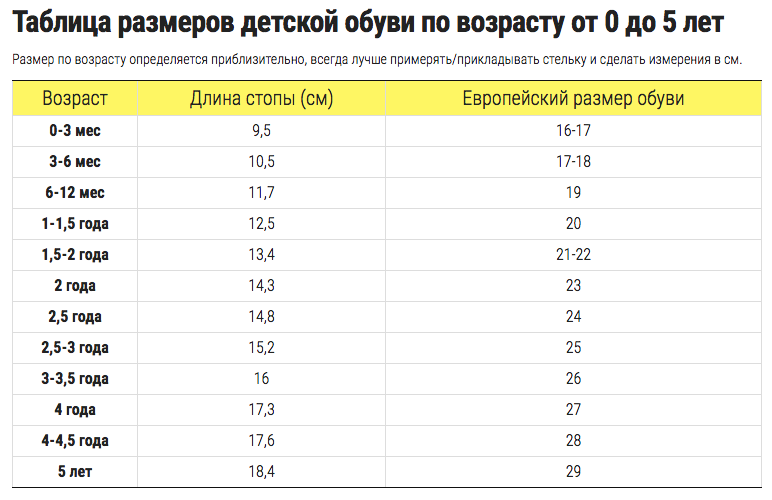
Kids’ Shoe Size Chart by Age in cm (0 to 5 Years)

My child got his first real shoes at about 8 months, when he started standing confidently while holding on to something. They were summer sandals which, according to our orthopedist, met all the requirements for children’s shoes, plus a pair of equally good sneakers. Both were by Kotofey (a Russian children’s shoe brand), which I knew nothing about but had heard lots of good things about from other shoppers chatting in the store. The choice was spontaneous, but it turned out to be a great one.
Kids’ Shoe Size Chart by Age, 0 to 5 Years
| Age | Foot length (cm) | EU shoe size |
|---|---|---|
| 0-3 mo | 9.5 | 16-17 |
| 3-6 mo | 10.5 | 17-18 |
| 6-12 mo | 11.7 | 19 |
| 1-1.5 years | 12.5 | 20 |
| 1.5-2 years | 13.4 | 21-22 |
| 2 years | 14.3 | 23 |
| 2.5 years | 14.8 | 24 |
| 2.5-3 years | 15.2 | 25 |
| 3-3.5 years | 16 | 26 |
| 4 years | 17.3 | 27 |
| 4-4.5 years | 17.6 | 28 |
| 5 years | 18.4 | 29 |
How to Find Your Child’s Shoe Size
- To choose the right shoes for your child, the easiest way is to trace their foot in pencil on a sheet of paper beforehand and measure, in cm, the distance from the tip of the big toe to the center of the back edge of the heel. This gives you an approximate size. It’s important to measure both feet and go by the larger one if there’s any difference.
- The next important point (especially for closed shoes): if you can take out the insole, do it and hold it against the foot. Ideally, have your child stand on it: there should be up to 1 cm of room, but no more.
A Few Key Features of Kids’ Shoes. What to Look For:
- a firm heel counter
- a small heel — preferably not a completely flat sole
- fasteners that let you adjust the shoe to fit the foot just right
- built-in arch support
Head Circumference by Age Chart